August 05, 2018

The Travel of the Soul in Solstices and Equinoxes and the Masonic Tracing Boards

Masonic Tracing Boards
               Tracing boards are painted or printed illustrations depicting the various emblems and symbols of Freemasonry. They can be used as teaching aids during the lectures that follow each of the Masonic Degrees when an experienced member explains the various concepts of Freemasonry to new members. They can also be used by experienced members as self-reminders of the concepts they learned as they went through their initiations. From Wikipedia
Ancient Craft Masonry
Craft Masonry was reckoned from the date of the creation of the world –  Anno Lucis  A.L. approximately 4000 years before the Common Era,  as we read in the third verse from the Book of Genesis in the King James version of the Bible as well as in the Torah.
             1:1 – In the beginning, God created the heaven and the earth.
            1:2 – And the earth was without form and void, and darkness was upon the face of the deep. And the Spirit of God moved upon the face of the waters.
               1:3 – And God said, Let there be light: and there was light.
The History of the Immortal Soul Teaching            
              Ancient Egyptians, like other pagan peoples, observed the unending cycles of nature: in the heavens, the sun seemed to be reborn each morning and die each night; spring was a time of birth, growth, and youth; autumn was a time of decline and old age; in winter plants died and even the sun seemed to fight for its existence; and the following spring the cycle began anew. Historians record that Egyptians interpreted these patterns of life, death, and renewed life as applying to humans as well.
            The concept of the immortality soul teaching came from the Egyptians which civilizations lasted for more than  3,000 years. The countless tombs unearthed by archaeologists along the Nile provide eloquent testimony to the Egyptian belief that man possessed a spiritual aspect extending beyond his physical life.
Passed on to Greeks
               The Greeks got the concept of an immortal soul from the Egyptians.  Plato, the Athenian Philosopher (428-348 B.C.), like his teacher, Socrates was initiated into the Greater Mysteries at the age of 49. The initiation took place in one of the subterranean halls of the Great Pyramid in Egypt.  Plato was the founder of the Academy, an institute for philosophical and scientific research just outside of Athens.
       It was Plato who popularized the immortal soul concept throughout the Greek world.  In the Phaedo, one of Plato’s most famous works, he recounts Socrates’ final conversation with his friends on the last day of Socrates’ life. Socrates declared to them:
           “The soul whose inseparable attitude is life will never admit of life’s opposite, death. Thus the soul is shown to be immortal and since immortal, indestructible… Do we believe there is such a thing as’ death? To be sure. And is this anything but the separation of the soul and body? And being dead is the attainment of this separation when the soul exists in herself and separate from the body, and the body is parted from the soul. That is death… Death is merely the separation of the soul and body.”
Aristotle  (384–322 BC) was an ancient Greek philosopher and scientist born in the city of Stagira, Chalkidiki, in the north of Classical Greece. Along with Plato, Aristotle is considered the “Father of Western Philosophy”, and is known for the Chaldean order of the astrological principles of the journey of the soul by alighting at each of the planets spheres descending from Saturn, Jupiter, Mars, the Sun, Venus, Mercury and the Moon. With the pure essence of each planet collected in its downward movement, the soul arrived at the moon where it waited for the correct moment of the native’s birth where physical manifestation took place and soul joined with the body.
From the Ancient Egyptians, Babylonians,  Greeks, and the Romans,  Freemasons learned from them the writings the philosophies and rituals which became the main principles of Masonic teachings.
Summers Solstice
, the soul descends in Cancer as depicted in the Masonic Tracing Board  of  Entered Apprentice Masons Degree
Masonic Tracing Board 1st degree
Soul descends from Heaven by way of Jacobs Ladder allegory through the tropical point cardinal water Cancer, the Gate of Men.  The canopy of heaven with the hottest time of the year in the Fire Leo Sun combines the two other luminaries, the Moon ruled by Cancer with cluster stars of the Pleiades in Taurus and the Blazing Star Sirius properly illustrated by Masonic Philosophers, a belief emanated from Ancient Egypt passed on to the Greeks and Romans Philosophers.
Roman Writer Macrobius Ambrosius Theodosius (390-430 CE) is famous for his classical Seven Books on Saturnalia. According to Macrobius, the galaxy crosses the Zodiac in two opposite points, Cancer and Capricorn, the tropical points in the sun’s course, ordinarily called the Gates of the Sun.  Through these gates, souls descend to earth and re-ascend to Heaven.  In Cicero’s Dream of Scipio, a discourse on the nature of the cosmos, the Gate of Men; and the other, the Gate of the Gods. Cancer was the former because souls descended by it to the earth, and Capricorn the latter, because by it they re-ascended to their seats of immortality and became Gods.
         According to Macrobius, the soul descended through the spheres of the seven planets as it descends from the highest heavens to manifest as a physical matter on earth. When the soul encounters Saturn’s heaven, the seventh sphere, it gains the power of reasoning and theorizing.
           In the next sphere, the sixth level closer to earth, the soul alights on Jupiter where it showed the Saturn’s gift of reason and critical analysis that can be put into practice so that the soul can direct the earthly body towards success or spiritual enlightenment.
          In the 5th heaven Mars, the soul obtains the passion, courage and zealous qualities to the soul.
         Below Mars, the soul encounters the Sun in the 4th level, where it meets glorious light in the purest form and envisages the potential for its own illumination or enlightenment. It absorbs the Sun’s spirit and brings with it the soul potential during the lifetime.
         In the third heaven Venus, the soul inherits the motion of desires, beauty, and balance.
        At the second level from earth, Mercury bestows the power of language and communication in order for it to be capable of interpreting human feelings and giving expression to its emotions.
        When the soul enters the Moon’ realm the sphere nearest to Earth, the soul absorbs the Moon’s essence which includes the awareness that it will soon experience the changes of physical movement, growth, and eventual decay.
        When the soul is drawn towards the body, it begins to experience a material agitation, matter flowing into it and likens to the human experience of drinking excessive amounts of alcohol as Plato’s remarked in the Phaedo.
The Seven Ages of Man
Moon                     0  –  4               years old
Mercury               4  –   14             years old
Venus                   14  – 22             years old
Sun                        22 – 41             years old
Mars                      41 –  56            years old
Jupiter                    56  – 68           years old
Saturn                    68  –  98          years old
Moon                    98   –  102         years old

33 Degree Scottish Rite Freemason Albert Pike’ summarized in his book Morals and Dogma the journey of the soul from heaven to earth;
         “The ancient Philosophers regarded the soul of man as having had its origin in Heaven. That was, Macrobius says, a settled opinion among them all; and they held it to be the only true wisdom, for the soul, while united with the body, to look ever toward its source, and strive to return to the place whence it came. Among the fixed stars it dwelt, until, seduced by the desire of animating a body, it descended to be imprisoned in matter.
              Let us, in order to understand this old Thought, first follow the soul in its descent. The sphere or Heaven of the fixed stars was that Holy Region, and those Elysian Fields, that were the native domicile of souls, and the place to which they re-ascended when they had recovered their primitive purity and simplicity. From that luminous region the soul set forth, when it journeyed toward the body; a destination which it did not reach until it had undergone three degradations, designated by the name of Deaths; and until it had passed through the several spheres and the elements.
               All souls remained in possession of Heaven and of happiness, so long as they were wise enough to avoid the contagion of the body and to keep themselves from any contact with matter. But  those who, from that lofty abode, where they were lapped in eternal light, have looked longingly toward the body, and toward that which we here below call life, but which is to the soul a real death; and who have conceived for it a secret desire,–those souls, victims of their concupiscence, are attracted by degrees toward the inferior regions of the world, by the mere weight of thought and of that terrestrial desire.
           The soul, perfectly incorporeal, does not at once invest itself with the gross envelope of the body, but little by little, by successive and insensible alterations, and in proportion as it removes further and further from the simple and perfect substance in which it dwelt at first. It first surrounds itself with a body composed of the substance of the stars; and afterward, as it descends through the several spheres, with ethereal matter more and grosser, thus by degrees descending to an earthly body; and its number of degradations or deaths being the same as that of the spheres which it traverses.
           This fiction is also found in Virgil. “If souls,” says Macrobius, “carried with them into the bodies   they occupy all the knowledge which they had acquired of divine things, during their sojourn in the Heavens, men would not differ in opinion as to the Deity; but some of them forget more, and  some less, of that which they had learned.”
         The celestial bodies, Heaven, the Stars, and the other Divine elements, ever aspire to rise. The soul reaching the region which mortality inhabits tends toward terrestrial bodies and is deemed to die. Let no one, says Macrobius, be surprised that we so frequently speak of the death of this soul, which yet we call immortal. It is neither annulled nor destroyed by such death: but merely enfeebled for a time; and does not thereby forfeit its prerogative of immortality; for afterward, freed from the body, when it has been purified from the vice-stains contracted during that connection, it is re-established in all its privileges, and returns to the luminous abode of its immortality.
            All this agrees with the doctrine of Plato, that the soul cannot re-enter into Heaven until the revolutions of the Universe shall have restored it to its primitive condition, and purified it from the effects of its contact with the four elements.” …From Morals and Dogma by Albert Pike.
Autumnal Equinox
, the soul with the earthly body is in a temporal sojourn to balance the movement of time in cardinal air Libra, savoring the pleasure of good harvest in the Eleusinian Mystery Rite of Demeter and Persephone.
masonic tracing boards in LIbra
The interlaced male principle and the female denote sexuality, the ancient symbolism of the communion of the Hierophant and the High Priestess to celebrate the bountiful harvest in Hieros Gamos holy ceremony,  the opening and closing of the Masonic Lodge is an allegory.
         As the Time passes, the soul is allowed to rest before moving into the transformative struggles of a Scorpio incarnation. A sense of self, it has been developed during the first six zodiac signs; now, Libra will focus on relationships, on balancing the personality and soul while relating to the external world.
      The person who is Libra incarnated to search for the soul mate. Libra attempts to balance the polarities of life, especially as they relate to the masculine and feminine energies.
The soul was fortunate and happy under the Empire of the first six; and began to be sensible of evil, when it passed under the Balance or Libra, the seventh sign. Thus the soul entered the realm of Evil and Darkness when it passed into the Constellations that belong to and succeed the Autumnal Equinox; and it re-entered the realm of Good and Light, when it arrived, returning, at those of the Vernal Equinox. It lost its felicity by means of the Balance and regained it by means of the Lamb. This is a necessary consequence of the premises, and it is confirmed by the authorities and by emblems still extant.
Sallust the Philosopher, speaking of the Feasts of Rejoicing celebrated at the Vernal Equinox, and those of Mourning, in memory of the rape of Persephone, at the Autumnal Equinox, says that the former was celebrated, because then is effected, as it was, the return of the soul toward the Gods; that the time when the principle of Light recovered its superiority over that of Darkness or day overnight, was the most favorable one for souls that tend to re-ascend to their Principle; and that when Darkness and the Night again become victors, was most favorable to the descent of souls toward the infernal regions.
For that reason, the old astrologers, as Firmicus states, fixed the locality of the river Styx in the 8th degree of the Balance. And he thinks that by Styx was allegorically meant the earth.
Emperor Julian gives the same explanation but more fully developed. He states, as a reason why the august Mysteries of Demeter and Persephone were celebrated at the Autumnal Equinox, that at that period of the year men feared lest the impious and dark power of the Evil Principle, then commencing to conquer, should do harm to their souls.
They were a precaution and means of safety, thought to be necessary at the moment when the God of Light was passing into the opposite or adverse region of the world; while at the Vernal Equinox there was less to be feared, because then that God, present in one portion of the world, recalled souls to Him, he says, and showed Himself to be their Saviour. He had a little before developed that theological idea, of the attractive force which the Sun exercises over souls, drawing them to him and raising them to his luminous sphere. He attributes this effect to him at the feasts of Atys, dead and restored to life, or the feasts of Rejoicing, which at the end of three days succeeded the mourning for that death; and he inquires why those Mysteries were celebrated at the Vernal Equinox.
The reason, he says, is evident. As the sun, arriving at the equinoctial point of Spring, drawing nearer to us, increases the length of the days, that period seems most appropriate for those ceremonies. For, besides that there is a great affinity between the substance of Light and the nature of the Gods, the Sun has that occult force of attraction, by which he draws matter toward himself, by means of his warmth, making plants to shoot and grow, etc.; and why can he not, by the same divine and pure action of his rays, attract and draw to him fortunate souls?
Then, as light is analogous to the Divine Nature and favorable to souls. struggling to return to the first principle, and as that light so increases at the Vernal Equinox, that the days prevail in duration over the nights, and as the Sun has an attractive force, besides the visible energy of his rays, it follows that souls are attracted toward the solar light. He does not further pursue the explanation; because he says, it belongs to a mysterious doctrine, beyond the reach of the vulgar and known only to those who understand the mode of action of Deity, like the Chaldæan author whom he cites, who had treated of the Mysteries of Light, or the God with seven rays.
Winter Solstice
Soul ascends to Heaven cardinal earth Capricorn as depicted by Winding Stair’s representation in the Fellowcraft Degree Tracing Board
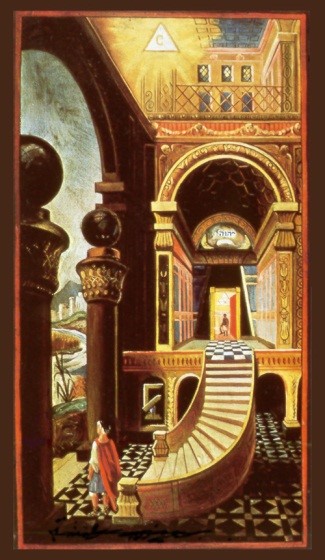
masonic tracing boards in Capricorn
Depicted on the tracing board is St John the Baptist at the foot of the winding stair and St John the Evangelist at the entry of the Middle Chamber
             On its return, it restores to each sphere through which it ascends, the passions and earthly faculties received from them: to the Moon, the faculty of increase and diminution of the body; to Mercury, fraud, the architect of evils; to Venus, the seductive love of pleasure; to the Sun, the passion for greatness and empire; to Mars, audacity and temerity; to Jupiter, avarice; and to Saturn, falsehood and deceit: and at last, relieved of all, it enters naked and pure into the eighth sphere or highest Heaven..  from Morals and Dogma
The ascending  pattern  is the reverse  of the descent which starts from the Moon, the Sun, Mercury, Venus, Mars, Jupiter, then Saturn until enters the eight sphere of the highest Heaven,
All this agrees with the doctrine of Plato, that the soul cannot re-enter into Heaven until the revolutions of the Universe shall have restored it to its primitive condition, and purified it from the effects of its contact with the four elements.” …From Morals and Dogma by Albert Pike.
 A CAPRICORN incarnation is one of initiation—the “gateway through which the Accepted Disciple, having walked the Path of life through nine tests (or zodiac signs), is now ready to culminate her journey and ascend to the Mountaintop.”  (Oken)  Whereas Cancer is the “gate in,” CAPRICORN is the “gate out” where freedom from the personality, by successfully passing the initiatory tests, is granted.

Vernal Equinox 
the Master Masons allegory of the death and rebirth of the soul
masonic tracing boards in Vernal Equinox
Let us follow the path of the soul journey in heaven after its ascent to the Gate of the Gods in the Winter Solstice Capricorn.  From Saturn reverse travel to the moon in water element Pisces to end its journey in a symbolical death to reborn again in the vernal equinox. The end of the mystery cycle of the sun to be resurrected again in the spring equinox.
Resurrection is defined as being:
          “a coming to life again; rising from the dead.”
A second definition given for this word is, “a being alive again after death.”
THE HIRAMIC DEATH AND REBIRTH
The Hiramic legend is a symbolic death and rebirth of the soul in the vernal equinox because its teachings and rites are consistent with the Ancient Mystery Schools principles on the immortality of the soul.
Initiation into the Ancient Mysteries was not simply a means of attaining intellectual knowledge or learning. Aristotle wrote that it was actually the “experience” and not knowledge learned, that allowed the initiate to comprehend the secret meaning of the mysteries. This enlightening, transformative experience has generally been termed rebirth and appears to be the central theme of the most important rituals of almost all the Ancient Mystery Schools as well as modern initiates organizations.
At Eleusis, the teaching on rebirth was revealed through the symbolism of Persephone’s descent into the underworld, her ascension from it, and the subsequent return of fertility. In the cults of Osiris, Dionysus, Attis, and Adonis, the main rite is their violent death and rebirth. In Mithraism, we find representations of Mithras slaying a bull whose blood turns into a grain. In Christianity, the unjust crucifixion of Christ leads to the ultimate redemption of mankind. And within Freemasonry, we learn of the murder of our beloved Grand Master Hiram Abiff by three impatient craftsmen and his subsequent raising.
It appears that all the violent deaths—of Osiris, of Christ, of Hiram—have something in common. They symbolize vice, ignorance, and chaos, inevitably slaying the pure self and thereby making rebirth necessary for salvation. These legends reveal the nature of our circumstances and enlighten us to the trials that we must overcome. Only through the death of one’s imperfect self, the leaving behind of the old, and acceptance of transcendent truth, can one truly be reborn into a new self, no longer tainted by the sins of one’s past. In a certain sense, and depending on one’s perspective or religious background, rebirth or regeneration is a process that is constantly occurring.
The main body of surviving Hermetic wisdom is called the Corpus Hermeticum and, incidentally, book 13 of the Corpus is entitled On Rebirth. The text is in the form of a dialogue between Hermes Trismegistus and his son Tat.
Tat begins by asking his father to reveal the teaching on rebirth, by saying that he is now “ready to become a stranger to the world,” as this was the condition that Hermes had previously set forth. Hermes then explains that all things come from God and are one with God, and it is His will only that determines who shall achieve rebirth.
The dialogue continues with Hermes teaching Tat that it is only through mastery of self and transcending of the senses that the Divine intellect, or Nous, can be discovered.
The soul in heaven suffers the symbolical death after completion of its journey to be reborn again as a new soul to start another beginning for its downward descent to earth. The new cycle begins.
“Thus the scientific theories of the ancients, expounded in the Mysteries, as to the origin of the soul, its descent, its sojourn here below, and its return, were not a mere barren contemplation of the nature of the world, and of the intelligent beings existing there. They were not an idle speculation as to the order of the world, and about the soul, but a study of the means for arriving at the great object proposed, the perfecting of the soul; and, as a necessary consequence, that of morals and society.
This Earth, to them, was not the Soul’s home, but its place of exile. Heaven was its home, and there was its birth-place. To it, it ought incessantly to turn its eyes. The man was not a terrestrial plant. His roots were in Heaven. The soul had lost its wings, clogged by the viscosity of matter. It would recover them when it extricated itself from matter and commenced its upward flight.
Matter being, in their view, as it was in that of St. Paul, the principle of all the passions that trouble reason, mislead the intelligence, and stain the purity of the soul, the Mysteries taught man how to enfeeble the action of matter on the soul, and to restore to the latter its natural dominion. And lest the stains so contracted should continue after death, lustrations were used, fastings, expiations, macerations, continence, and above all, initiations. Many of these practices were at first merely symbolical,–material signs indicating the moral purity required of the Initiates; but they afterward came to be regarded as actual productive causes of that purity.
The effect of initiation was meant to be the same as that of philosophy, to purify the soul of its passions, to weaken the empire of the body over the divine portion of man, and to give him here below a happiness anticipatory of the felicity to be one day enjoyed by him, and of the future vision by him of the Divine Beings. And therefore Proclus and the other Platonists taught “that the Mysteries and initiations withdrew souls from this mortal and material life, to reunite them to the gods; and dissipated for the adepts the shades of ignorance by the splendors of the Deity.” Such were the precious fruits of the last Degree of the Mystic Science,–to see Nature in her springs and sources, and to become familiar with the causes of things and with real existences.
Cicero says that the soul must exercise itself in the practice of the virtues if it would speedily return to its place of origin. It should, while imprisoned in the body, free itself therefrom by the contemplation of superior beings, and in some sort be divorced from the body and the senses. Those who remain enslaved, subjugated by their passions and violating the sacred laws of religion and society, will re-ascend to Heaven, only after they shall have been purified through a long succession of ages.
The Initiate was required to emancipate himself from his passions, and to free himself from the hindrances of the senses and of matter, in order that he might rise to the contemplation of the Deity, or of that incorporeal and unchanging light in which live and subsist the causes of created natures.
“We must,” says Porphyry, “flee from everything sensual, that the soul may with ease re-unite itself with God, and live happily with Him.” “This is the great work of initiation,” says Hierocles;–“to recall the soul to what is truly good and beautiful, and make it familiar therewith, and they its own; to deliver it from the pains and ills it endures here below, enchained in matter as in a dark prison; to facilitate its return to the celestial splendors, and to establish it in the Fortunate Isles, by restoring it to its first estate. Thereby, when the hour of death arrives, the soul, freed of its mortal garments, which it leaves behind it as a legacy to earth, will rise buoyantly to its home among the Stars, there to re-take its ancient condition, and approach toward the Divine nature as far as man may do.”
Plutarch compares Isis to knowledge, and Typhon to ignorance, obscuring the light of the sacred doctrine whose ‘blaze lights the soul of the Initiate. No gift of the gods, he holds, is so precious as the knowledge of the Truth, and that of the Nature of the gods, so far as our limited capacities allow us to rise toward them. The Valentinians termed initiation LIGHT.
The Initiate, says Psellus, becomes an Epopt, when admitted to seeing THE DIVINE LIGHTS. Clemens of Alexandria, imitating the language of an Initiate in the Mysteries of Bacchus, and inviting this Initiate, whom he terms blind like Tiresias, to come to see Christ, Who will blaze upon his eyes with greater glory than the Sun, exclaims: “Oh Mysteries most truly holy! Oh, pure Light! When the torch of the Dadoukos gleams, Heaven and the Deity are displayed to my eyes! I am initiated, and become holy!”
This was the true object of initiation; to be sanctified, and TO SEE, that is, to have just and faithful conceptions of the Deity, the knowledge of Whom was THE LIGHT of the Mysteries. It was promised the Initiate at Samothrace, that he should become pure and just. Clemens says that by baptism, souls are illuminated, and led to the pure light with which mingles no darkness, nor anything material. The Initiate, become an Epopt, was called A SEER. “HAIL, NEW-BORN LIGHT!” the Initiates cried in the Mysteries of Bacchus.
Such was held to be the effect of complete initiation. It lighted up the soul with rays from the Divinity, and became for it, as it was, the eye with which, according to the Pythagoreans, it contemplates the field of Truth; in its mystical abstractions, wherein it rises superior to the body, whose action on it, it annuls for the time, to re-enter into itself, so as entirely to occupy itself with the view of the Divinity, and the means of coming to resemble Him.
Thus enfeebling the dominion of the senses and the passions over the soul, and as it was freeing the latter from a sordid slavery, and by the steady practice of all the virtues, active and contemplative, our ancient brethren strove to fit themselves to return to the bosom of the Deity. Let not our objects as Masons fall below theirs.
We use the symbols which they used; and teach the same great cardinal doctrines that they taught, of the existence of an intellectual God, and the immortality of the soul of man. If the details of their doctrines as to the soul seem to us to verge on absurdity, let us compare them with the common notions of our own day, and be silent. If it seems to us that they regarded the symbol in some cases as the thing symbolized, and worshipped the sign as if it were itself Deity, let us reflect how insufficient are our own ideas of Deity, and how we worship those ideas and images formed and fashioned in our own minds, and not the Deity Himself: and if we are inclined to smile at the importance they attached to lustrations and fasts, let us pause and inquire whether the same weakness of human nature does not exist to-day, causing rites and ceremonies to be regarded as actively efficient for the salvation of souls.”..Morals and Dogma
References:

July 01, 2018

Societas Rosicruciana in Civitatibus Foederatis , Pearl of the Orient College,

     Annual Ingathering June 25, 2018 at Grand Lodge of the Philippines
     Me at left most - second row.


Societas Rosicruciana in Civitatibus Foederatis

The Societas Rosicruciana in Civitatibus Foederatis is a Rosicrucian Society based in the United States of America extending from its formation of a Grand High Council on April 21st, 1880 and its official consecration on September 21, 1880, by three Colleges chartered by the Societas Rosicruciana In Scotia.High Grade Christian Freemasons in the United States in search of the Classical Rosicrucian Society for Masons in the United Kingdom became interested in organizing a similar body in the United States and did so under Scotland’s authority (Societas Rosicruciana In Scotia) with the help of Most Worthy Charles Matier of the SRIS, as early as 1873.  

This effort died out two years later under the care of R.W. Frater George S. Blackie VIII and was then re-chartered by the SRIS later again in 1878. Dr. Jonathon J. French[3] was a IX grade head of the Rosicrucian Society of the United States & opened the Matier Royal Provincial College with a charter from Lord Inverurie, Earl of Kincore and Supreme Magus of the SRIS.  The college was named after Charles Fitzgerald Matier, the first Supreme Magus of SRIS who served in 1876.   Harold Van Buren Voorhis insists that the Illinois College under Dr. French was never truly active, and it certainly was short-lived as Dr. French died an untimely death in 1879.  Harold Voorhis also insisted that Frater Stodart Blackie’s early charter in New York had been nothing more than an unsubstantiated rumor.  It has since been established as historical fact.

In 1878 a group of senior U.S. Masons (Daniel Sutter, and Charles W. Parker) led by Charles E. Meyer (1839-1908) of Pennsylvania traveled to England and on July 25th, 1878 were initiated into the grade of Zelator at Yorkshire College at Sheffield[4]. They applied for a charter, but getting no response, turned to Scotland and received a charter from the college in Edinburgh in 1879. 

Scotland’s Society is actually the oldest as Walter Spencer is recorded as having been initiated into the SRIS by Anthony Oneil Haye in 1857, and there are documents in the SRIA archives that show that both Robert Wentworth Little and William J. Hughan were initiated in 1866 & 1867 by Anthony O’Neal Haye, Magus Max, Ros. Soc. Scot. With H.H.M. Bairnfathur signing as Secretary.  The Societas Rosicruciana in Anglia was formed in England in 1866 by Robert Wentworth Little.  The SRIA later felt the need to charter the current SRIS on October 24, 1873.

A second charter was granted by the SRIS for a college in New York, and Fratres from Philadelphia and New York met in Philadelphia on April 21, 1880 and formed a High Council, then known as the SRRCA or the Societas Rosicrucianae Reipublica Confoedera America, was later changed to the Society of Rosicrucians in the USA by Most Worthy Frater Shryock in his capacity as Supreme Magus and then properly Latinized in 1934 by & at the suggestion of Dr. William Moseley Brown under the regime of Most Worthy Frater Hamilton.  Brown composed the name (Societas Rosicruciana In Civitatibus Foederatis)  himself and submitted it on January 17th, 1934.  The SRICF has operated continuously since its formation in the 19th Century, and is thriving today with an upsurge of young Masons being invited into its ranks with great enthusiasm and demonstrated scholarship.

Membership is by invitation only & predicated on regular mainstream Masonic affiliation as well as a profession of Christian faith.  Membership was initially restricted to 36 members per College, but this was changed in 1908 by MW Thomas Shryock to 72 members per college.  The See of the High Council is in Washington, D.C.   The SRICF is in amity with the SRIS (Scotia) and the SRIA (Anglia) as well as the SRIC (Canada) and has helped the cause of Rosicruciana by empowering High Councils in their own sovereignty around the World.  They are: the SRIL in Lusitania (Portugal), SRIG in Gallia (France) & the SRIR (Romania).

The society issues an annual journal known as Ad Lucem composed of academic articles on things related to Rosicrucianism & esoteric streams of Christian Mysteries.  There is also an annual report, The Rosicrucian Fama.  Many of the Colleges have their own individual organs[7] which are produced quarterly as well as annually. The governing body of the Society is known since 1911 (having dropped ‘Grand’ from its title) as The High Council which is composed of Fratres of the Third Order (IX and VIII), plus any College Celebrant not a member of the Third Order. 

The head of the Society is titled The Supreme Magus who was elected ad vitam up until circa 1991 when the constitution of the Society was changed to reflect that Supreme Magi are elected each triennium.  Unlike the SRIA in England, a Chief Adept in the SRICF does not have regional powers, but rather is in charge of an individual College.  Typically there is but one College per state, exceptions having been made for both New York and California due to their size and population.


Degree Structure:

First Order
Grade I – Zelator
Grade II – Theoricus
Grade III – Practicus
Grade IV – Philosophus

Second Order
Grade V – Adeptus Minor
Grade VI – Adeptus Major
Grade VII – Adeptus Exemptus

Third Order
Grade VIII – Magister
Grade IX – Magus


KGC~ Knight Grand Crosses are awarded to IX grade Magi for exemplary effort in the work of the Society & Rosicrucianism in general.
[1] Scotland chartered the Pennsylvania College on Dec. 27, 1879. This was followed by charters being issued to New York on April 9, 1880, Massachusetts on May 4, 1880
[2] Dr. George S. Blackie VIII given charter by Matier, SM of the SRIS, for a College in NYC (source:  Bruce Wilson)
[3] March 17th, 1879 letter to Sir John O. Dominis, Governor of Oahu, Hawaiian Kingdom
[4] Mark Merckle also of PA was admitted to Metropolitan College
[5] Among its members were Kenneth R. H. Mackenzie, Dr. William Wynn Westcott (an honorary Magus of the SRICF) and W. R. Woodman, who were among the founders of the Hermetic Order of the Golden Dawn
[6] charter was issued by the SRIA to form East of Scotland College in Edinburgh.  This college was renamed “Metropolitan College” in 1874.  The High Council of SRIS was constituted ion January 13th, 1876.
[7] Ex-LI College in NYC, North Carolina & Louisiana College all title their publication as “LVX”
The jewel is a miter from which is suspended a red ribbon and jewel.

May 02, 2018

Fixed Stars in Natal Astrology

The influence of the fixed stars differs from that of the planets in being much more dramatic, sudden and violent. As a rule planetary effects are gradual and operate comparatively slowly, one might almost say softly, whereas the stars appear to exercise most of their influence in sudden, hard, vehement bursts, producing tremendous effects for short periods, and, after raising the natives to a great height, dropping them suddenly and bringing a series of dramatic and unexpected disasters. 

In other words the fixed stars may elevate from poverty to the extreme height of fortune or vice versa, whereas the planets do not do so. It may be taken as a fairly well-established rule that the stars do not operate alone, except perhaps in those cases where they are situated on angles, and that their chief effect is transmitted by the planets. They seem to form an underlying basis upon which the horoscope is built, and if a planet falls upon a star its effect is greatly magnified, giving it a prominence in the life that is quite unwarranted by its mere position and aspects in the map. 

Cases are known to all astrologers in which a certain planet in a horoscope seems to be emphasized for no apparent reason {p.93}, so that it acts drastically throughout the life, and in a case such as this there is usually a fixed star in operation in the background through the planet concerned.

The extent and magnitude of the effects brought about by the stars depend upon several factors, namely, (a) apparent size, (b) celestial position, (c) nature of planet through which they operate, and (d) general nature of the horoscope.

(a) Apparent size: The magnitude of a star bears a definite relationship to its intensity. A 1st magnitude star is of great power, a 2nd magnitude star is appreciably weaker, and so on down the scale, the effect of the stars below the 4th magnitude being very small except in the case of clusters.
(b) Celestial position: The nearer a star may be to the ecliptic the greater is its power, and in the northern hemisphere a star with north declination is more powerful than one with south, the reverse holding good in the southern hemisphere. It has frequently been said that stars with great latitude cannot affect us, but it is very doubtful if this assumption is correct, and experience, particularly in the case of comets, seems to indicate that bodies in all parts of the celestial sphere are capable of exerting an influence upon the earth and its inhabitants.

(c) Nature of planet through which they operate: As already pointed out the fixed stars give strength and energy to the planets and modify their effects but at the same time the nature of the planet exercises a strong controlling influence upon the result. {p.94} The greatest effect is obtained when the star and planet are both of the same nature, and in such cases the influence of the planet is raised to a vehement pitch, though at the same time the malefic effect of the star is diminished. Thus if the planet Mars fall upon a star of its own nature its power is increased; if upon a star of the nature of Jupiter or Venus it is reduced and modified; while if upon one of the nature of Saturn it is greatly changed. In other words if a planet falls upon a star of similar nature to its own it acquires intensity, while if upon one of contrary nature it becomes quiescent or distorted and may give a kind of sodden or dull effect to the character.

(d) The general nature of the horoscope: This is an important consideration and should not be forgotten. The result of the effect of a star upon a planet depends largely upon the strength or weakness of that planet in the horoscope. Thus in a map showing great ability and high position the success attained by the aid of a star will be of a more lasting nature than in one where this is not indicated. Furthermore, in all cases the fixed stars do not contradict the planetary indications. A man will not become a murderer, thief or forger merely through the effect of a star alone, and for this to take place the general nature of the map must be suitable and in harmony with such indications. The chief function of the stars is to emphasize qualities rather than to bestow them, and the exact nature and effect must be sought through the ordinary rules of astrology. Similarly in directions {p.95} the action of the stars is much more potent if a planetary direction of a like nature is in force at the same time.

The fixed stars operate by position and are said to "cast no rays," or in other words their aspects are said to be ineffective and their influence to be exerted only by conjunction and parallel. As in the case of the planets they are most powerful when in angles and weak when cadent, their effect being very marked when rising, culminating, setting or on the nadir even when alone. In such cases all 1st magnitude stars give honor and preferment, which will be lost or retained with trouble and danger if the star be of the nature of Mars, while if it be like Saturn there will be final disgrace and ruin. The particular angle occupied exerts its own modifying effect, the 10th house influencing the profession, the 7th the wife, the 4th the home, and the 1st the native himself.
The most powerful effect of a star is exercised when it is in conjunction or parallel with a planet, and a great deal of information on this will be found in the next chapter. It is usual to take the conjunction in exactly the same way as a planetary conjunction in a horoscope, that is, by the degree of ecliptic longitude affected by the star, and the parallel by its declination, and these positions are the only orthodox ones to use. It will be found, however, that the opposition is almost as powerful as the conjunction, and that the square has an undeniable influence which it will be unwise to neglect [I am inclined to disagree with him about the squares having effect - Anne Wright]. In the case of the trines and sextiles very {p.96} little effect, if any, is to be discovered, but in all probability this is due to the fact that, with the exception of the square and opposition, the aspects to the body of a star with latitude do not fall in the zodiacal degrees one would expect, as may be seen by the example given in the Appendix under Formula 8. It is a simple matter, however, to calculate the correct places in which such aspects fall and if this is done in a few cases it will soon be possible to arrive at a definite conclusion as to their power. The same difficulty is met with in the rising and setting of stars and a further reference to the Appendix will show that when the ecliptic longitude of a star is rising or setting the actual body of the star itself may be a long way above or below the horizon. 

This is particularly important when examining the angular effect of a star which may operate either through its ecliptic longitude or its bodily position, and also in computing primary directions, for in many cases the direction Ascendant conjunction star in mundo is impossible as it neither rises nor sets in the latitude at which the birth took place. Full details will be found in the Appendix enabling the student to determine for any latitude the zodiacal degrees with which a given star rises and sets, but there will be no necessity to calculate these unless he wishes to examine mundane angular influences and mundane primary directions.

One other point arises in connection with the action of stars and that is the "line of Right Ascension." It bas been suggested that a star may operate through the degree to which its R.A. corresponds. {p.97} Thus Algol now at 26Taurus10 has R.A. 45degrees44 (date?),which when converted directly into longitude without latitude corresponds to 18Tau12. Those who wish to experiment with this idea will find the method of converting R.A. into longitude without latitude in Formula 9 of the Appendix.

It will be noticed that all the influences described in the following chapter are expressed in terms of the radical horoscope and no allowance has been made for directions. This is done for the simple reason that the directional influences are exactly the same, the only difference being that they do not persist throughout the life. Therefore in studying the effects of directions the same delineations may be used if it is borne in mind that they are of a transitory nature and not lasting. Either primary or secondary directions may be used and both are calculated in the usual way.

It now remains only to consider the actual natures of the fixed stars and the manner of representing them. The generally accepted method of expressing the kind of influence exerted by any star is in terms of the planets of our Solar System. Thus a certain star may be "of the nature of Mars" for example, and this implies that it possesses characteristics similar to those exhibited in a horoscope by that planet. Frequently, however, two or more planets are mentioned, and in this case that one whose name is mentioned first is considered to represent the chief influence of the star. The second one denotes a kind of modifying influence, so that a star of the nature of Mars and Jupiter for example has {p.98} an influence similar to that of Mars but modified by Jupiter. Thus the purely martial qualities are given an expansiveness by Jupiter, there is more optimism and good luck than would otherwise be the case, and so on. The effect is something like that of a promittor passing to the conjunction of a significator in directional astrology, the former being represented in our example by Jupiter and the latter by Mars. It will follow from this, of course, that the effect of a star of the nature of Jupiter and Mars would be somewhat different for the emphasis would in this case be upon Jupiter, and Mars would add fire and energy to the Jupiterian characteristics.

This method of classifying and describing the exact natures of the stars enables us to gain a good idea of each, and if it is combined with the sign and decanate occupied by the star, together with the planet and house through which the star is acting in any given map, we may refine our judgment of its specific effect considerably, and also estimate the way in which any other little-known star is acting, for its nature may be known from the general character of the constellation to which it belongs.

How these natures were first discovered or fixed we do not know, for Ptolemy, to whom we are indebted for them, gives no rules for their determination That he followed some sort of rule seems certain for otherwise it is difficult to see how the fine shades of influence could be appreciated.

 According to Agrippa the natures of the fixed stars are known from the similarity of their colors {p.99} to those of the planets, which he describes as follows

Saturn, blue, leaden and shining; Jupiter, citron near to paleness and clear; Mars, red and fiery Sun, yellow, and when rising red, afterwards glittering; Venus, white and shining, white in morning, reddish in evening; Mercury, glittering; Moon, fair: and to these might perhaps be added Uranus, bright and greenish; and Neptune, also greenish but not so bright. This method, however, does not commend itself as a very scientific one, and it is extremely doubtful if it is that used by Ptolemy.

The general effect of the stars of any given nature in terms of natal astrology is as follows:

URANUS: Interest in occultism, electricity, aviation, antiquities; abrupt. If rising, eccentricity gained by learning. If culminating, learned, eminent in arts and sciences, mechanical and inventive ability.
SATURN: Disgrace, ruin, calamity. It rising, grave, thoughtful, melancholy, liable to disgrace, much care and anxiety, connected with building, mines and minerals. If on 7th cusp and Moon afflicted by Saturn ruler of 7th, a slovenly wife. If culminating, trouble through old people, disgrace, trade losses, deceitful associates, rise followed by fall. With the luminaries, lean and infirm, many miseries. If afflicting Mercury, deafness.
JUPITER: If rising, sober, grave, patient, legacies, ecclesiastical preferment. If culminating, honor, glory, preferment, success in trade and in the Church.
{p.100.}MARS: Violent death, ultimate ruin by folly or pride. If rising, wealth, power, courage, generosity, ingenuity, rise to authority, martial success, subject to cuts, wounds, accidents, sores and injuries to the face, pains in the head and fevers. If culminating, martial eminence, success in trade and in occupations of a Mars nature. If afflicting Mercury, deafness.
VENUS: If rising, good fortune, happiness, gifts, fortunate for love and marriage, gain by legacies and inheritance. If culminating, honor and success, dealings with and help through women, success in occupations of a Venus nature.
MERCURY: If rising, honor, intellect, great learning. If culminating, business activity, gain through books and intellectual matters.
SATURN-JUPITER: Dignified, pious, conservative, acquisitive, retentive. Honor and preferment if culminating.
SATURN-MARS: Bold, cruel, heartless, adulterous, criminal, liar, loss of estates, poverty, few friends. if of 1st magnitude, rises by usury or unfair means. If culminating, bad name, rise by trade followed by disgrace and ruin.
SATURN-VENUS: Slovenly, very immoral, shameless, revolting, mean, sorrows in love. If rising, good-tempered, healthy, gain by industry and marriage. If culminating, improved health, fame by help of superiors.
SATURN-MERCURY: Profound liar, thief, blackguard, scandal and slander.
JUPITER-SATURN: Legacies, inheritance, fame, especially {p.101} if rising, but foolish and unfortunate in love affairs. If culminating, honor and preferment.
JUPITER-MARS: High ambition, pride, love of power, grandeur of view, If rising, military honors. If culminating, high ecclesiastical honor, martial preferment, prosperity in business.
JUPITER-VENUS: Contented, happy disposition, honorable, philosophical mind, legal or ecclesiastical preferment, help through women. If rising or culminating, honor and riches.
JUPITER-MERCURY: Religions mind, thoughtful, philosophical, writer on religious or similar subjects.
MARS-SATURN: Malicious, thieving, merciless, fiendish, repulsive, liar, accidents, violent death. If culminating, military preferment but final disgrace.
MARS-JUPITER: Great pride, grandly liberal, commanding, cosmopolitan views. If rising or culminating, military honor and preferment.
MARS-SUN: Heroic, courageous, defiant, intrepid leader, warlike, danger to the eyes, violent death. If rising, preferment to metal workers, soldiers, surgeons, and other Mars people. If culminating, preferment in business and in all martial affairs.
MARS-VENUS: Strong passions, artistic feeling, gain through women and friends, honor and preferment in martial affairs, especially if rising or culminating.
MARS-MERCURY: High enterprise, combative, destructive. If rising, rash, very obstinate, ruined by headstrong and precipitate conduct. If culminating, changeable in business.
{p.102}MARS-MOON: Adventurous, perfidious, insolent, wanton, brutal, danger to eyes. If rising, sore eyes, weak sight, trouble and loss through women. If culminating, disgrace and imprisonment.
SUN-MARS: Fearless, in tolerant, warlike skill, over-confident, fierce, cruel, vindictive, energetic organizer, danger to the eyes, accidents, violent death.
VENUS-SATURN: Cunning, bad morals, mercenary, repulsive habits, perverted tastes, unfortunate love affairs, seduction.
VENUS-JUPITER: Refined, good, high morals, vivacious, sincere, pure, healthy, artistic, fortunate in love and marriage, help through relatives.
VENUS-MARS: Shameless, vain, self-indulgent, abandoned, violent passions, danger of seduction, riotous living but often self-respecting and decent.
VENUS-MERCURY: Idealistic, psychic, handsome, neat, lovable, refined, genteel, intelligent.
MERCURY-SATURN: Subtle, studious, keen and profound mind, often shameless liar, interested in occult or serious subjects.
MERCURY-JUPITER: Optimistic, cheerful, philosophical, broad mind, religious views, success through influential friends or the Church and law.
MERCURY-MARS: Exaggerative, argumentative, unreliable, unscrupulous, given to invective, mechanical ability, very quick mind, great talker.
MERCURY-VENUS: Courteous, affable, orderly, elegant, sweet-tempered, lovable, refined, artistic, honor and riches, If rising, love of poetry, painting and teaching, quick mind. {p.103} If culminating, success in literary and legal professions.
MOON-MARS: Changeable, passionate, wanton, liable to accidents especially when travelling, bad eyes, injuries to face.
NEBULAE AND CLUSTERS: Blindness, disease, accidents, fevers, quarrels, rape, murder, banishment and decapitation.
No difficulty should be experienced in using the fixed stars in natal astrology, but for the benefit of the beginner the following rules may be laid down
I. Note on the map or make a list of the fixed stars that fall in conjunction and parallel with, or in opposition to, the planets, together with their magnitudes and natures. The following orbs may be allowed for conjunction and opposition For a 1st magnitude star, 7degrees 30minutes; for a 2nd magnitude, 5degrees 30minutes; for a 3rd magnitude, 3degrees and 40minutes; and for a 4th magniude star, 1degree and 30minutes. [I totally disagree with these orbs, most people give about 1degree to 1 for fixed stars of 1st magnitude. I would give Sirius a maximum of 2 degrees. Sirius is by far the brightest star. I give a 1st magnitude star about 1degree 15 minutes, gradually decreasing to 15 minutes for a 6th magnitude star. - Anne Wright].
2. Look up the constellation containing the star, its nature as tabulated above, and the combined influence of star and planet.
3. Modify these characteristics by the sign, decanate and house occupied, together with the aspects to the planet and the houses it rules just as would be done in the case of an ordinary planetary conjunction.
4. The magnitude of the star and its angular, succeedent or cadent position will give some idea of the strength likely to be exhibited.
As an example we may take the horoscope of the {p.104} ex-Kaiser, who was born at Berlin on 27 January, 1859, at 3 p.m. The chief positions are as follows; Ascendant conjunction Pollux, M.C. and Neptune conjunction Markab, Mars conjunction Scheat, Uranus conjunction, and Moon opposition, Pleiades, and Mercury conjunction Wega.
The most striking position is Markab, a 2nd magnitude Mars-Mercury star in Pegasus on the M.C. and in conjunction with Neptune and Mars. This star brings disgrace and ruin, and with Neptune gives a romantic, emotional and unbalanced mind, while the constellation Pegasus gives vanity, ambition and bad judgment - a disastrous attempt to find "a place in the Sun" if one may apply the legend literally. The nature of the star is combative, destructive and aggressive, and its particular mode of operation is greatly influenced by Mars conjunction Neptune afflicted by Sun and Saturn, which indicates martial megalomania and downfall. We should, therefore, expect these characteristics to be tremendously emphasized and matters connected with them to end in a crash of a far greater magnitude than Mars conjunction Neptune would indicate alone.
Furthermore, Pollux, a martial star, is rising, indicating imprisonment and honor of short duration, while the Moon is heavily afflicted by Uranus from the Pleiades giving deformity (the ex-Kaiser has a paralyzed arm) and heavy losses at the end of life, together in such a case as this with revolutions and popular outbreaks caused by Uranus falling on a star of the nature of the Moon and Mars.
At the outbreak of the war in 1914, the Kaiser's {p.105} Sun was separating from Difda (Deneb Kaitos), and Mars from Hamal and the Ascendant was in conjunction with Regulus. The last position is a very significant one indicating military honour and success but ultimate failure. Difda (Deneb Kaitos) also denotes self-destruction by brute-force, while Hamal is a violent and destructive star of the nature of Mars and Saturn, which with Mars gives final disgrace and ruin.
Another interesting study is that of the Emperor Franz Josef of Austria, whose life was a succession of disasters, many of which were due to the position of the Sun, Moon and Saturn in conjunction with Alphard in the neck of the Hydra, but examples could be multiplied indefinitely and the student will soon discover for himself that the use of the fixed stars and constellations is indeed a valuable help to the understanding of a horoscope.

  The Fixed Stars and Constellations in Astrology, Vivian E. Robson 1923, Ascella Publications, UK, ISBN: 1 898503 50 8.

Gab in 2025 .12 .12

Thanksgiving for All Souls I Have Met on My Journey December 12, 2025 Great Architect of the Universe, Divine Source of all paths and all de...